The U.S. cold chain market continues to expand as demand for temperature-controlled storage and transportation grows. Beyond fresh and frozen food, pharmaceuticals, vaccines, biological products, and emerging medical therapies are creating increasingly stringent requirements for cold storage, transportation, and temperature monitoring. Developments in the U.S. market also offer valuable insights for Southeast Asia and Vietnam.
Globally, cold chain infrastructure is becoming increasingly important for the movement of temperature-sensitive goods. Growth in the food, pharmaceutical, and e-commerce sectors is driving investment in cold storage facilities, specialized transportation, and temperature-control systems.
Against this backdrop, the United States has one of the most developed cold chain markets. The industry is gradually moving beyond a storage-focused model toward solutions capable of controlling cargo conditions throughout the entire storage and transportation process.
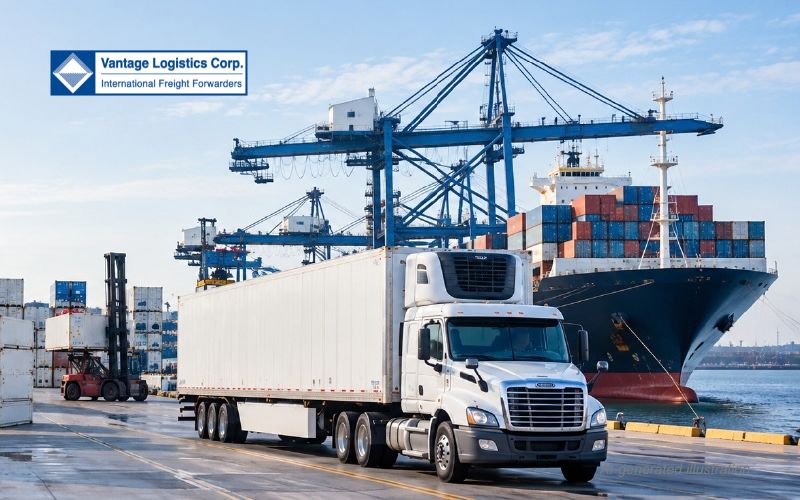
According to data cited by the Vietnam Logistics Portal from Mordor Intelligence, the U.S. cold chain market is expected to reach USD 97.13 billion in 2026 and USD 133.87 billion by 2031, representing a compound annual growth rate (CAGR) of 6.63%.
Cold storage remains a major component of the market, accounting for 57.53% of the market in 2025. Meanwhile, air cold chain logistics is projected to be the fastest-growing transportation segment, with a CAGR of 13.23% through 2031.
By temperature range, frozen products accounted for 61.42% of the market in 2025, while the deep-frozen and ultra-cold segment is expected to grow at a CAGR of 11.87%.
Healthcare is another important growth area. The vaccines and clinical trial materials segment is projected to grow at a CAGR of 14.11%, significantly outpacing several traditional cold chain segments.
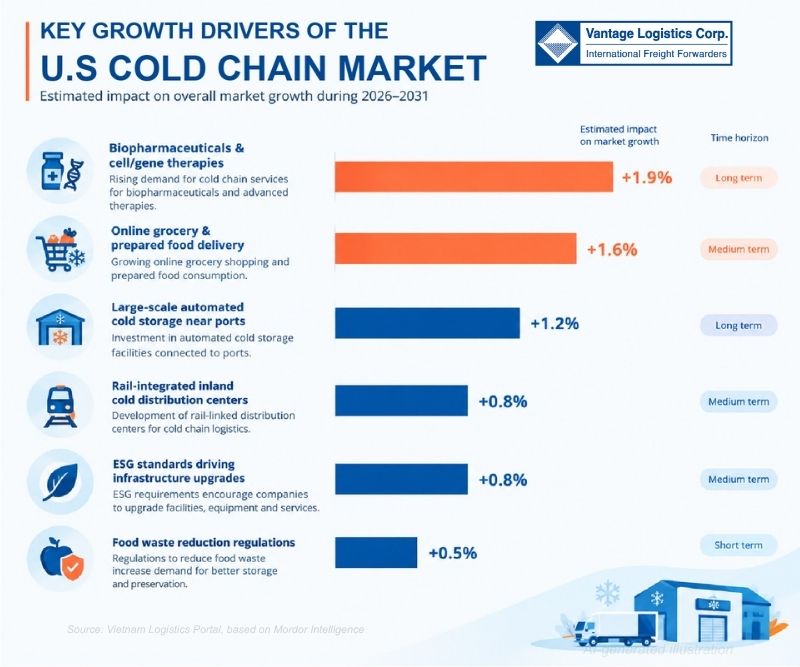
Several factors are supporting the expansion of the U.S. cold chain market, particularly changes in consumer behavior and growing demand for products requiring specialized temperature control.
Despite its positive outlook, the U.S. cold chain market faces several significant barriers.
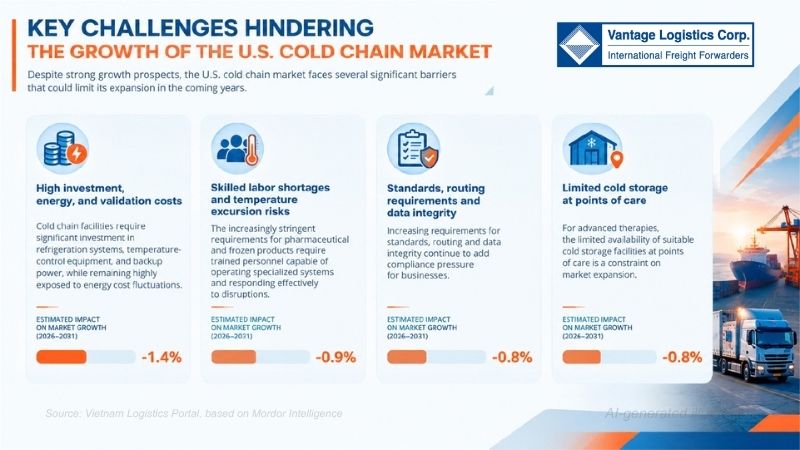
These growth drivers and challenges are accelerating the adoption of automation and technology across the U.S. cold chain industry. IoT, real-time temperature monitoring, data traceability, and automated management systems are becoming increasingly important for maintaining cargo conditions and improving operational control.
This is particularly relevant to biopharmaceuticals and cell and gene therapies, where the high value of cargo makes accuracy and control critical. Even a relatively short temperature deviation can result in significant losses, making backup power, remote monitoring, and data traceability increasingly essential components of cold chain operations.
Several trends emerging in the U.S. are also becoming increasingly relevant to Southeast Asia as demand for frozen food, agricultural products, pharmaceuticals, and e-commerce continues to grow. However, cold chain infrastructure remains uneven across the region.
In Vietnam, opportunities are particularly relevant to seafood, agricultural products, processed food, and pharmaceuticals. As export markets place greater emphasis on product quality and storage conditions, the ability to maintain stable temperatures, monitor shipments, and control risks throughout the supply chain will become increasingly important.
The U.S. experience shows that cold chain development is not simply about adding warehouses or refrigerated vehicles. Backup power, monitoring technology, operating standards, traceability, and integrated services will increasingly determine service quality and competitiveness.
From a system primarily associated with food preservation, cold chain logistics is evolving into a sector that combines infrastructure, technology, and operational control. Developments in the United States therefore offer more than a view of a major market; they also provide useful direction for the continued development of cold chain capabilities across Southeast Asia and Vietnam.
Contact Vantage Logistics for tailored transport solutions and competitive quotations.
Please provide details on cargo type, market, origin, destination, and estimated timeline.
|
Vantage Logistics Corp – South East Asia (S.E.A) Logistics Provider One-Stop Shop For Integrated Logistics Services |
|
|
Head Office |
Viet Nam – Suite 6.01, Floor 6th, Block A, RiverGate Residence, 151-155 Ben Van Don, Khanh Hoi Ward, HCMC, Viet Nam |
|
Branch |
Thailand, Laos, Cambodia, Malaysia, Indonesia, Singapore |
|
Contact Us |
|
|
|
info@vlc.com.vn |
|
Hotline |
+84-909-026-261 |
|
Website |
https://vantage-logistics.com |
Send your shipment enquiry today and receive a tailored transport plan from the Vantage Logistics team.

Leave a comment